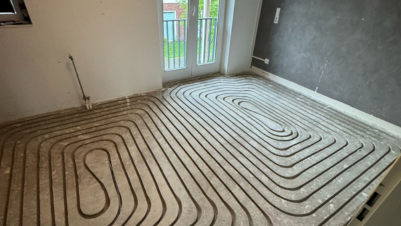
Milling underfloor heating into cement screed floor

An ALL-IN price: from installation to connection to central heating

Rated 4.7/5

Clear terms and conditions and digital signing
Your quote within 8 hours !

⭐⭐⭐⭐⭐ Rated 9.4

Many homes built after 1990 have a cement screed floor. If your home is relatively new, you might have a concrete floor. If underfloor heating wasn’t installed when your home was built, this can be done later, for example, by milling grooves in the floor. We’re very skilled at milling cement screed floors, and we’re happy to offer you an all-inclusive price.

That’s why you should mill into a cement screed floor at Infloor:

An ALL-IN price: from installation to connection to central heating

Rated 4.7/5

Clear terms and conditions and digital signing

Knowledge

What is a cement screed?

A floor consists of multiple layers, including the floor covering, with the top layer underneath. The top layer sits directly beneath the laminate, PVC, or carpeting. Most homes built since 1990 have a thick (cement) screed. This is convenient, as a cement screed allows for both shrinkage netting and the milling of underfloor heating into the screed. If a good screed is present, we often choose to mill the new underfloor heating.

Knowledge

What is a cement screed?

A floor consists of multiple layers, including the floor covering, with the top layer underneath. The top layer sits directly beneath the laminate, PVC, or carpeting. Most homes built since 1990 have a thick (cement) screed. This is convenient, as a cement screed allows for both shrinkage netting and the milling of underfloor heating into the screed. If a good screed is present, we often choose to mill the new underfloor heating.

1
Step 1
Remove old floor
2
Step 2
Milling the underfloor heating
3
Step 3
Laying underfloor heating hoses
4
Step 4
Hanging the distributor
5
Step 5
Final testing & finish

Milling underfloor heating

By milling the underfloor heating into the subfloor, it is neatly concealed. We perform this milling process using specialized equipment.

Step 1

Milling underfloor heating

By milling the underfloor heating into the subfloor, it is neatly concealed. We perform this milling process using specialized equipment.

Milling underfloor heating

By milling the underfloor heating into the subfloor, it is neatly concealed. We perform this milling process using specialized equipment.

Milling underfloor heating

By milling the underfloor heating into the subfloor, it is neatly concealed. We perform this milling process using specialized equipment.

Milling underfloor heating

By milling the underfloor heating into the subfloor, it is neatly concealed. We perform this milling process using specialized equipment.

Milling underfloor heating

By milling the underfloor heating into the subfloor, it is neatly concealed. We perform this milling process using specialized equipment.

Benefits of milling underfloor heating into cement screed floors

Milling underfloor heating into a cement screed offers several advantages. These advantages are largely comparable to milling into a concrete floor, but they remain characteristic of milled underfloor heating systems.

  • Faster response time: the system dissipates heat quickly, allowing the room temperature to adjust rapidly.
  • Ease of installation: no additional floor needs to be installed, making the process more practical in many situations.
  • No need to remove the screed: the existing cement screed is reused by milling grooves directly into it.
  • Easier than a concrete floor: cement screed is less hard than concrete, which makes milling easier.
  • ALL-IN price: we use our own materials, allowing us to offer a clear and complete all-in price.

Disadvantages of milling underfloor heating into cement screed

Every advantage has its disadvantage. Milling underfloor heating into a cement screed also has its drawbacks, which is why professional installation is essential.

  • Other pipes in the screed: cement screeds often contain additional pipes. We always perform a test milling first to locate them, minimizing the risk of damage.

How thick should the cement screed be?

A cement screed must be at least 2.5 to 3 centimeters thick. This ensures enough depth for the heating pipes, which are milled to a depth of approximately 2 centimeters.

How long does the floor need to dry before underfloor heating can be installed?

After the pipes are installed, the system is pressurized and the grooves are filled with quick-drying mortar. Drying time depends on temperature and mortar thickness, but most floors are walkable again after about four hours.

🔥 Reviews

What do our
customers
say?

⭐⭐⭐⭐⭐
Rated 9.2

Kowsar Saleh

60 m²Underfloor heating

Very satisfied “Underfloor heating has been installed and we are very satisfied!”

Kowsar Saleh

60 m²Underfloor heating

Very satisfied “Underfloor heating has been installed and we are very satisfied!”

Kowsar Saleh

60 m²Underfloor heating

Very satisfied “Underfloor heating has been installed and we are very satisfied!”

#1 in underfloor heating

We combine craftsmanship with clear communication. With us, you know exactly what to expect, from quote to delivery.